
Is Your VDI Provider Exiting the Country?
The Hidden Business Continuity Risk No One Is Talking About
Your VDI Provider May Be Your Biggest Business Continuity Risk
Private equity consolidation, rising renewal costs, and shrinking local support teams are quietly increasing risk across enterprise VDI environments.
The Risk Your Register Isn’t Capturing
Technology leaders prepare for cyberattacks and outages. Few plan for vendor structural risk — when a critical provider weakens due to financial decisions, not technical failure.
Across the VDI market, the same pattern is emerging: private equity takeovers, aggressive renewals, reduced local teams, offshore support, and slower innovation.
For regulated industries like finance and healthcare, this is more than a vendor issue. When VDI supports core operations, provider stability becomes a board-level business continuity risk..
Executive Summary
- PE-backed software vendors reduce R&D by ~20–30% within two years and increase renewal pricing by 18–34% on average (Bain 2024; Gartner 2024).
- Standard vendor evaluations assess product capability at purchase — not long-term investment trajectory.
- VDI lock-in is structural; enterprise migrations typically require 9–18 months.
- Ownership model, regional staffing, and capital allocation are leading indicators of continuity risk.
- Forward-looking enterprises evaluate alternatives 18–24 months before renewal to preserve leverage.
Enterprise risk frameworks rigorously assess cybersecurity, compliance exposure, and infrastructure resilience.
They rarely assess Structural Vendor Risk — the gradual weakening of a critical provider due to ownership change, cost optimization, or capital reprioritization.
In enterprise VDI environments, where virtual desktops underpin regulated and distributed operations, vendor trajectory directly affects continuity.
Market data shows the pattern is measurable:
- 72% of PE-backed software acquisitions implement headcount reductions within 18 months (McKinsey, 2023).
- R&D investment falls by an average of 23% within 24 months post-acquisition (Bain, 2024).
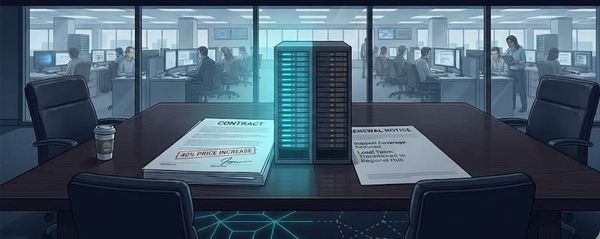
- Renewal pricing rises 18–34% as prior discounting leverage narrows (Gartner, 2024).
The issue is not product failure. It is incentive shift.
The Problem
Private equity acquisition in enterprise software typically unfolds in three phases.
1. Reassurance (0–12 months)
- Roadmaps appear stable
- Contracts remain unchanged
- Messaging emphasizes continuity
Customer churn is minimized while ownership establishes control.
2. Cost Optimization (12–24 months)
- R&D narrows toward maintenance
- Local engineering and support are reduced
- In-country roles migrate offshore
- Release cadence slows
The platform remains functional. Investment posture changes.
3. Renewal Leverage
- Discounting declines
- Contract flexibility narrows
- Pricing reflects switching cost

VDI environments are deeply integrated across identity, networking, storage, security, and endpoints. In large enterprises, migration commonly requires 9–18 months due to compliance controls and change-management processes.
That timeline materially reduces renewal leverage.
The relationship shifts from partnership to incumbency economics.
Why It Matters for Enterprises
In financial services, healthcare, and public sector environments, VDI is operational infrastructure.
Effective delivery requires:
- In-country escalation and regulatory familiarity
- Alignment with OS and security release cycles
- Sustained compliance and data residency investment
- Senior technical continuity
These capabilities depend on ongoing capital allocation. They are not fully secured by SLA language.
Risk compounds incrementally:
- Resolution cycles lengthen
- Escalation paths weaken
- Security patch alignment slows
- Compatibility gaps accumulate
By the time operational metrics reflect degradation, migration windows are often constrained.
For regulated industries, structural switching barriers are higher — and the margin for reactive transition is narrow.
What’s Changing
Ownership as a Strategic Variable
A vendor optimizing for short-term EBITDA behaves differently from one investing for long-term platform durability.
Differences are observable in:
- Hiring patterns
- R&D allocation
- Release cadence
- Support model design
- Renewal posture
Ownership structure should be treated as a formal risk signal in enterprise governance.
The Economics of Lock-In
VDI lock-in is architectural by design.
Structural drivers include:
- Proprietary management layers
- Limited configuration portability
- Non-standard deployment tooling
- Undocumented migration paths
Deep integration creates operational efficiency. It also increases switching friction.
In renewal cycles, pricing often reflects exit difficulty more than incremental value creation.
Enterprises that adopted single-vendor architectures without defined portability carry higher exposure.
What Resilient VDI Strategy Looks Like
A forward-looking enterprise posture includes:
- Formal assessment of ownership and capital allocation trends
- Architectural designs that preserve portability
- Documented migration frameworks
- Market evaluation 18–24 months before renewal
Governance questions to ask providers:
- Who owns the business today, and what is the investment horizon?
- How has regional technical headcount changed over the past two years?
- What percentage of R&D is allocated to this platform?
- What proportion of critical incidents are resolved in-country?
- What documented exit framework exists?
- Can you provide renewal references under current ownership?
Clear, data-backed responses indicate institutional stability.
A Structural Alternative
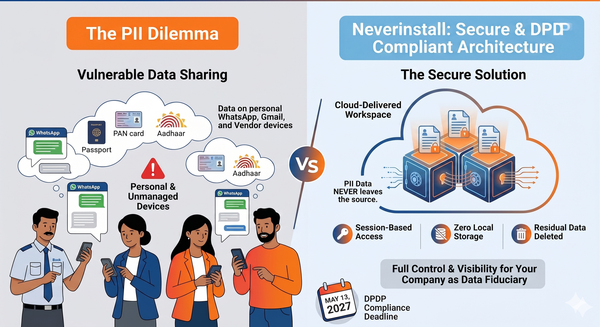
Neverinstall was built to remove the economic dynamics that create structural lock-in in legacy VDI models.
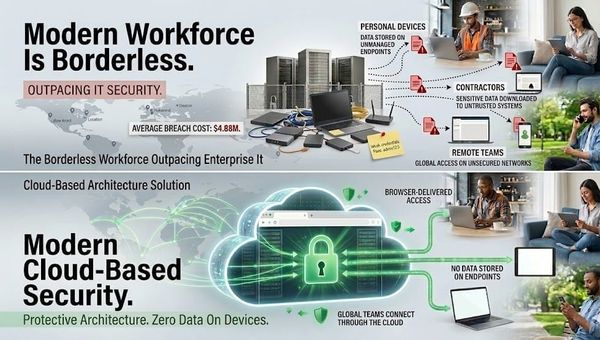
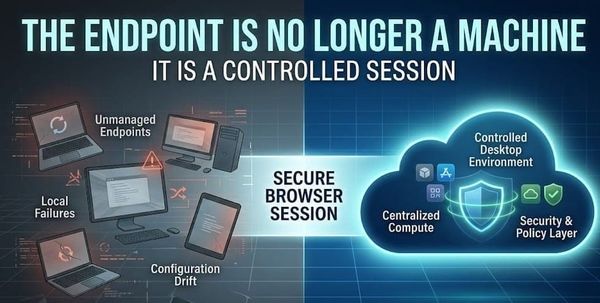
Our cloud-native, browser-delivered architecture:
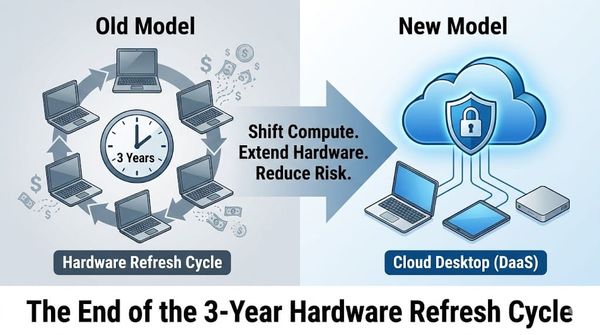
- Eliminates hardware refresh dependency
- Reduces integration complexity
- Preserves portability through open APIs
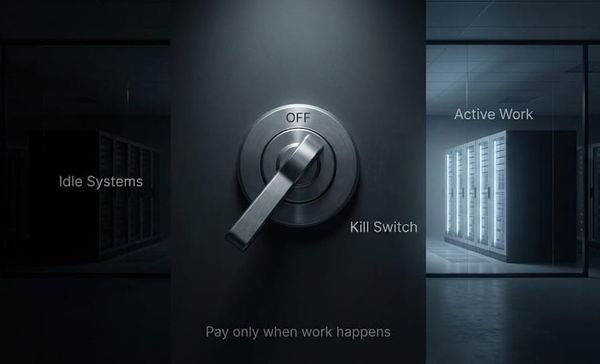
- Aligns cost to active usage rather than sunk infrastructure
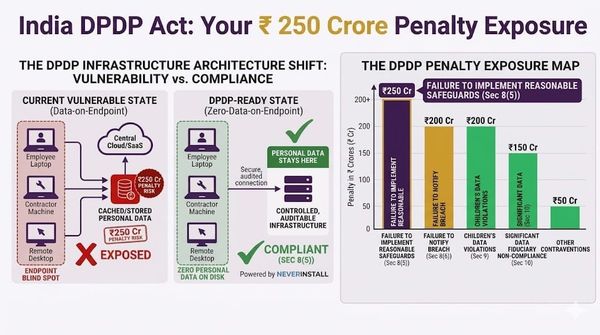
- Supports regulated enterprises with strict data residency and compliance requirements
The objective is straightforward: durable capability without renewal leverage distortion.

We recommend applying the same ownership, investment, and portability criteria to Neverinstall as to any other provider. Structural resilience should be verifiable, not assumed.
Conclusion
Vendor instability rarely presents as sudden failure. It accumulates through incremental shifts in capital allocation, staffing, and renewal mechanics.
In consolidated infrastructure markets, incentive alignment is as important as technical architecture.
CIOs who incorporate Structural Vendor Risk into formal governance — and begin evaluation well before renewal inflection points — retain strategic control.
Those who wait operate on the vendor’s timeline.
Enterprise continuity depends not only on platform performance, but on ownership intent.
Structural risk is manageable. It requires visibility, discipline, and early action.
© Neverinstall Inc. 2026 This brief is intended for senior technology and infrastructure leaders in enterprise organizations.