
The VDI Kill Switch: Why 2026 Budgets Will Punish Always-On Infrastructure
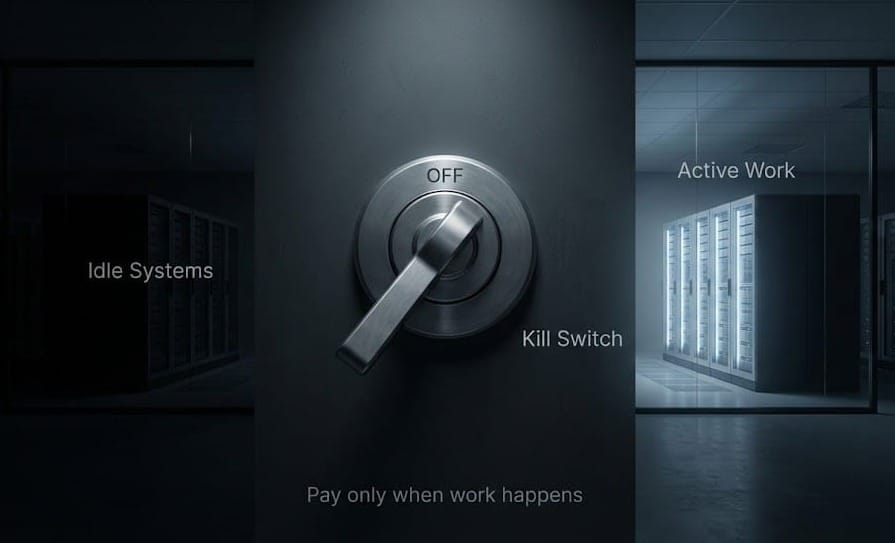
For more than a decade, Virtual Desktop Infrastructure has been sold as a control plane for risk: centralize compute, centralize data, centralize governance. For regulated industries—financial services, healthcare, government, manufacturing—that logic made sense. If endpoints are untrusted, move the workload to the data center or the cloud.
But somewhere along the way, VDI inherited the economics of legacy data centers: capacity-first, utilization-last.
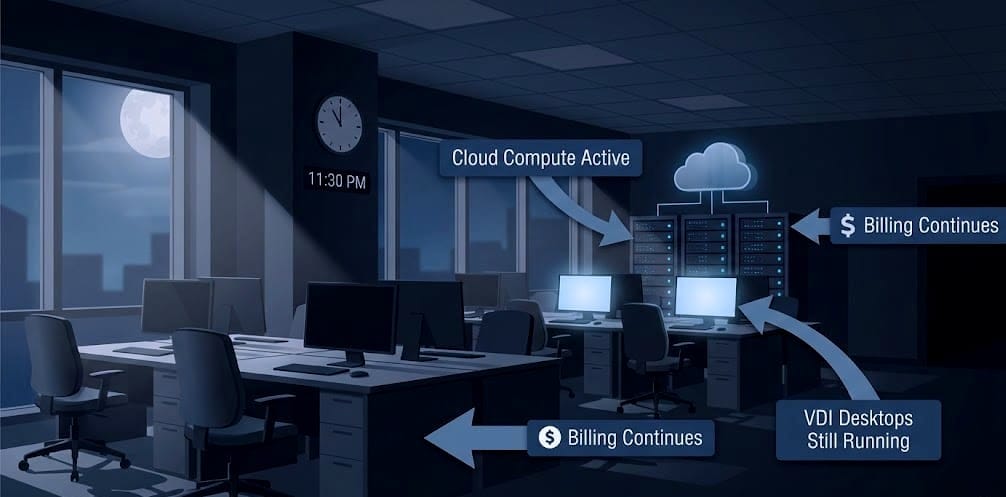
Most VDI and Cloud PC environments today behave like abandoned buildings with the lights left on. The desktops are technically “in use,” but the humans are not. And every minute of idle compute still shows up on the bill.
That model will not survive the next budget cycle.
CIOs are under pressure from two directions at once:
• Security and compliance requirements are getting stricter.
• Boards and CFOs are demanding real cost discipline from cloud spend.
VDI sits directly at that intersection. Which means VDI can no longer be treated as sacred infrastructure. It must behave like modern infrastructure: elastic, usage-based, and measurable.
That is the context in which the idea of a VDI Kill Switch becomes not just useful—but inevitable.
The Hidden Tax of “Always On” Desktops
Most VDI platforms claim pay-as-you-go. In practice, they meter in ways that still resemble leases:
• Billed per hour, not per minute
• Charged while idle
• Kept “warm” for faster login
• Reserved even when unused
This creates three structural failures:
1. Zombie Instances
Contractors forget to log out. Employees close laptops but sessions remain active. Test environments are never decommissioned. Multiply that across departments and geographies and you get silent budget leakage.
2. Budget Opacity
When compute runs whether work is happening or not, cost stops being tied to productivity. Finance sees a rising bill. IT cannot prove business value.
3. Risk Without Reward
Idle systems still need patching, still consume attack surface, still expand blast radius. You pay more while gaining nothing.
The tragedy is that this waste is normalized. It is accepted as “how VDI works.”
It doesn’t have to.
The Strategic Shift: From Provisioning to Intent
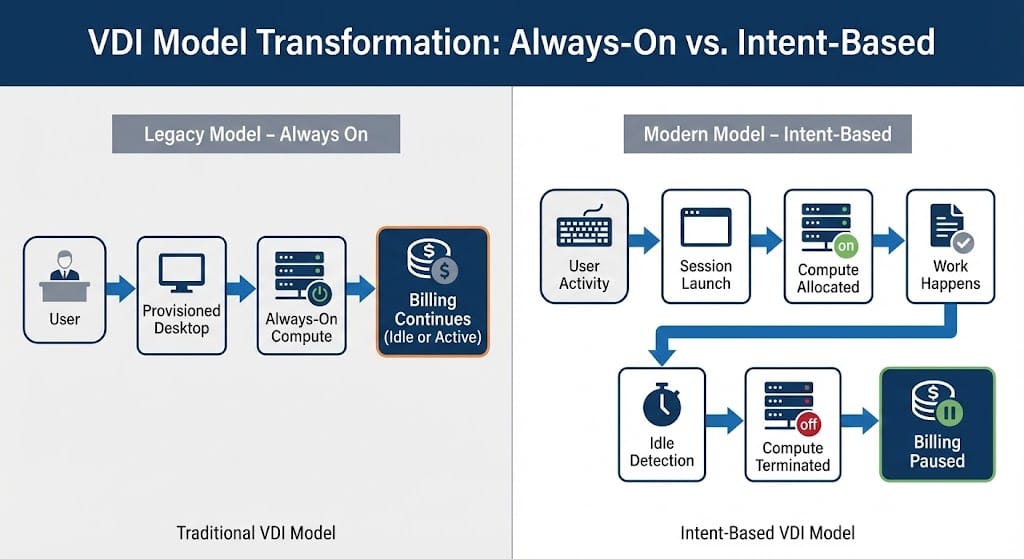
Modern infrastructure is no longer about provisioning machines. It is about understanding intent.
Intent answers one question:
Is someone actually working right now?
If the answer is no, then the system should not behave as if the answer were yes.
In Kubernetes, idle containers are killed.
In serverless, execution exists only while code runs.
In modern storage tiers, cold data moves to cheaper media.
VDI has largely missed this transition. It still assumes that presence equals value.
The Kill Switch model flips that assumption.
Instead of asking, “Is this desktop allocated?”
It asks, “Is this desktop being used?”
That distinction is subtle. It is also financially decisive.
What a VDI Kill Switch Really Means
A Kill Switch is not a marketing feature. It is an architectural stance:
• Idle sessions are automatically cut off after a defined window
• Compute is immediately deallocated
• State is preserved
• Restart is fast
• Billing stops when productivity stops
No human intervention. No admin cleanup. No weekend firefighting.
When the user returns, the workspace resumes where it left off.
From their perspective, nothing broke.
From finance’s perspective, the meter stopped.
This is not a power-saving trick.
It is a governance mechanism.
You are enforcing a simple rule:
We only pay for work.
Why This Matters More in Regulated Industries
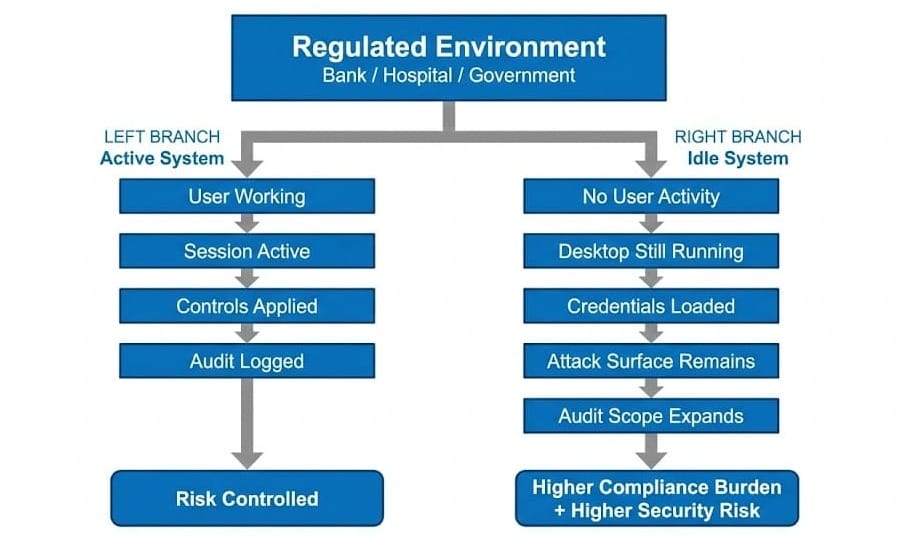
For regulated environments, infrastructure is not just a cost center. It is a compliance surface.
You already deal with:
• Data residency
• Audit logging
• Least privilege
• Zero trust
• Forensics
• Retention policies
Idle systems complicate every one of these.
A system that is running but unused is:
• Still holding credentials
• Still reachable
• Still mis configurable
• Still vulnerable
• Still in scope for audits
Which means:
More risk.
More controls.
More operational burden.
Killing idle environments reduces:
• Lateral movement opportunity
• Credential exposure
• Drift
• Patch urgency
• Scope of monitoring
In other words, cost control and security alignment stop being opposing forces.
That is the rarest win in enterprise IT.
Budgeting in 2026 Will Look Different
The CFO no longer wants capacity.
They want accountability.
A VDI environment that cannot answer these questions will be challenged:
• How many hours of real work happened last month?
• How many hours were idle?
• Which roles consume the most compute per output?
• Which environments are always on but rarely used?
Traditional VDI cannot answer these cleanly.
A Kill Switch model can.
Because billing aligns with actual human activity, you get:
• Cost per productive hour
• Department-level attribution
• Contractor efficiency visibility
• Seasonal demand modeling
This is not just cost cutting.
It is financial telemetry.
And once IT can speak in financial metrics, it stops being a black box.
The Organizational Consequence
When VDI stops charging for idleness, behavior changes:
• Teams stop hoarding desktops
• Access becomes easier to grant and easier to revoke
• Temporary users become cheap
• Project work becomes elastic
• Pilots stop being permanent
This alters how security teams think about exposure and how infrastructure teams think about provisioning.
Instead of asking, “Can we afford another 100 desktops?”
You ask, “How many hours of work do we expect?”
That is a fundamentally more mature question.
Why Browser-Based VDI Changes the Game
A Kill Switch only works if restart is trivial.
If relaunch takes minutes, users will resist.
If state is lost, users will complain.
If security resets, auditors will object.
Browser-native VDI removes that friction:
• No endpoint configuration
• No thick clients
• No device dependency
• No persistence risks
This is where Neverinstall takes a different architectural path.
Instead of treating desktops like long-lived machines, the platform treats them like sessions:
• Stateful when active
• Stateless when idle
• Disposable without data loss
This is not a UI choice.
It is a control-plane decision.
And it allows something that traditional VDI struggles with:
hard enforcement of idle policy without user disruption.
The Myth of “Warmth”
One of the strongest objections to aggressive idle shutdown is speed.
“We keep instances warm for performance.”
“We need instant resume.”
“Our users will complain.”
This logic is rooted in legacy VM boot times.
Modern session orchestration does not require warm machines.
It requires fast context restoration.
If the workspace can resume where it stopped, users do not care whether compute was running in between.
What they care about is continuity.
And continuity does not require waste.
This Is Not a Feature War
The Kill Switch is not competing with GPUs, protocols, or display quality.
It is competing with a mindset:
That infrastructure must be paid for even when unused.
That belief made sense in data centers.
It does not make sense in elastic cloud.
Regulated industries already operate under zero trust.
Now infrastructure must adopt zero waste.
What Infrastructure Leaders Should Ask Now
If you run or influence VDI strategy, ask yourself:
• How many desktops ran last weekend?
• How many people were actually working?
• How much did that cost?
• Who owns that spend?
• Can I defend it to a board?
If you cannot answer clearly, you have an optimization problem masquerading as a security platform.
The Strategic Outcome
A Kill Switch does not just reduce bills.
It reshapes:
• Access models
• Budget ownership
• Security posture
• Project economics
• Contractor onboarding
• Compliance scope
It aligns infrastructure behavior with business behavior.
That is what mature platforms do.
They stop pretending that uptime equals value.
Final Thought
The next phase of VDI evolution will not be driven by display codecs or GPU density.
It will be driven by accountability.
The organizations that win will be the ones that realize:
Idle infrastructure is not a technical issue. It is a governance failure.
A Kill Switch is simply the first policy that treats it as such.
If your VDI environment runs while your people sleep, your budget is lying to you.
And in 2026, that will no longer be acceptable.